Mexborough & Swinton Times – Friday 27 March 1903
Strike Leaders at the Assizes
The Intimidation Cases
Prisoners Bound Over
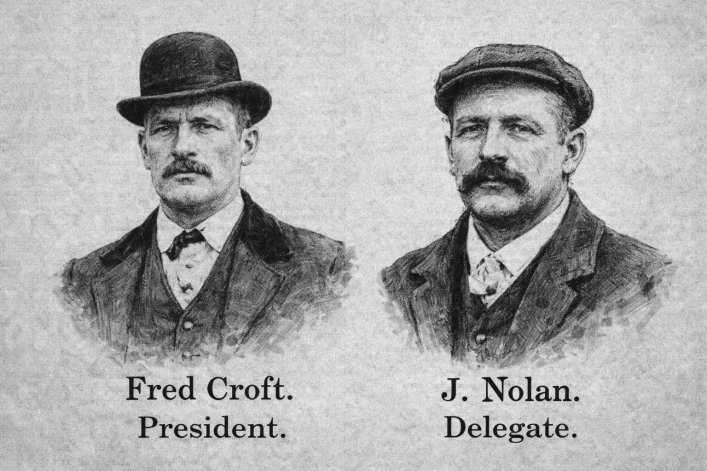
The name of the Denaby strikers had gone before them, and the Court at Leeds Assizes on Monday was crowded, when Mr. A. T. Lawrence (Commissioner), and a special jury, had before them Messrs. Fred Croft (55), Christopher Staniforth (39), and James Parker, who were brought up indicted under Section 7 of the Conspiracy and Protection of Property Act, 1875, on two charges, embracing three counts: (1) conspiring to intimidate certain employes, (2) conspiring to beset, (3) conspiring to follow in a disorderly manner.
John Nolan (37) was indicted that he, in company with other persons unknown, with a view to compel two other persons, unknown, to abstain from becoming employés of the Denaby and Cadeby Main Collieries, Ltd., did watch and beset the road to the said collieries, at Conisboro’, on February 10th. This case was to have been taken first, but in the absence of a material witness, it was decided, on the application of Mr. Waddy, to take the charges against Croft, Staniforth, and Parker first, all of whom pleaded not guilty.
In all the cases Mr. H. T. Waddy and Mr. W. H. Wilberforce, instructed by Mr. A. Neal, of Sheffield, were for the prosecution, and Mr. C. Mellor, instructed by Mr. Muir Wilson, Sheffield, was for the defence.
Opening Speech for the Prosecution
Mr. Waddy, in opening the case, said the proceedings were taken under Section 7 of the Conspiracy and Protection of Property Act, 1875. The charges against the men were three. First of all, that they conspired to intimidate; secondly, of besetting; thirdly, with following in a disorderly manner.
The Denaby and Cadeby Collieries, Limited, he said, were one of the largest coal undertakings in Yorkshire. They had two pits—one at Denaby, the other at Cadeby. The pits were about a mile apart, and in the ordinary course of business about 4000 men were employed.
Story of the Strike
Proceeding to give a brief outline of the fight of events in connection with the struggle, the learned counsel said that on the 29th of June last practically the whole of the men employed in the pits came out on strike. It was not necessary to enter into the merits of the case; the only question was whether those men had exceeded what they had a right to do in their combination as working men to effect the purpose for which the strike had been commenced.
A strike did not merely mean that the strikers themselves ceased work; it was an effort by combination on the part of the men who had then struck to prevent by some means other men from working in their places. The pits were closed on the 19th August, and on the 22nd January they were re-opened for work. The men with few exceptions had not gone back to work, but were standing loyal to their own union, or rather their own branch of the union.
The company, on the opening of the pits, had to apply to the world at large to get men, and the jury would be aware of the difficulties which arose in such cases. It was in respect of the treatment of the men who were brought in, and the free exercise of their legal right to work, that the men now before the Court were charged with exceeding the limits of the Act, and had been intimidating, besetting, or persistently following them.
Advertisements of the opening of the pit had been issued on the 5th and 6th February, and men began to arrive, and it became necessary for the strikers to adopt fresh tactics. It became necessary that they should find fresh means of stopping in some way or another the men who were presenting themselves for work.
The Processions
An important operation came into force on February 12th, and a system of processions was started. These processions were under the guidance of the president, Croft, and were so timed that they should reach the colliery yard at Denaby or Cadeby as the men were called “blacklegs” were coming off their ordinary shift work.
They would form their own conclusions as to what the effect of processions like that, some 1500 men in the ranks, would be on some 30 or 40 men who were working. The jury, he thought, would have no difficulty in considering whether it could be suggested that the processions were bona-fide, and that the people who took part in them were there for the bona-fide purpose of giving information within the meaning of the section of the Act of Parliament.
The Day of the Alleged Offence
On February 23rd the so-called “blacklegs” were gathered in the yard, near the inquiry office at the Denaby colliery. They were under the protection of the police, whom the Colliery Company had to provide for that purpose.
These “blacklegs”—he used the word for convenience, although he did not consider it a proper description of these men.
His Lordship: I think they might reasonably object to the term “blacklegs.” I should suggest you should refer to them as workers; they were the workers at the time.
Mr. Waddy accepted the advice, saying that he had read so much about “blacklegs” that he was afraid he had got it on the brain. (Laughter.)
Proceeding, Mr. Waddy said the procession that morning started from Mexboro’, headed by Croft, on instead of marching on to Conisboro’ as usual, stopped at the Denaby crossing, near by the office. Croft and a part of the procession went over the foot bridge, and when at the other side Croft held up his hands for the procession to stop, and gave orders for those on and over the bridge to return, reversing the procession, so that the former rear became the front.
The whole procession then moved in the direction of Mexboro’, and the men who lived at Denaby were able to go quietly home, without molestation. The procession of strikers had, in the meantime, halted at the bridge over the river Don about 300 yards from the colliery offices, and remaining 30 or 40 workmen left in the yard would have to pass the procession on their way to their homes at Mexboro’, and in that direction. The police escort was the same as that already mentioned, four sergeants, six constables.
That, said Mr. Waddy, was the sort of force required on even ordinary occasions to give the men protection from the strikers. Escorted by the police, the workmen set out on their march to Mexboro’, part of the police in front and another part behind. Before the men started the police inspector was so struck by the demeanour of the strikers that he telephoned for three mounted officers to be sent. The rear part of the strikers’ procession had stopped before getting to the bridge, and stood apart to let the police and their charges pass. The men closed up behind the workers and police, and the other part of the procession came in front of them, completely enveloping the workmen and their protectors.
Hooting and Booing
The procession was headed by Croft, who frequently passed up and down it, calling out orders or giving signals to the men to “boo and hoot,” although the 30 workers were only legitimately and properly on their way home from work. The procession soon became very disorderly. Parker was shouting “Boo, you ——,” and in consequence of the directions thus persistently given the booing went on almost incessantly until the police succeeded in getting the men to their homes. Staniforth shouted out more than once, “Give it to them,” and waved a board before a mounted policeman and rider, apparently to prevent him from giving assistance.
The jury would not forget what that sort of thing meant. It meant that men who had come, under some degree of fear, to approach work, were to be subjected, apparently, to further intimidation. If the men who had themselves come out, to this amount of violence and threatening day by day, the case disclosed a state of things that could not be allowed in any civilised community.
There was one worker named Gill who lived in a by-road called Dolcliffe Road, along which the procession had never gone before, and would not be likely to go except for the purpose of terrorising some individual man. With difficulty, the police had dropped at their houses each of the workers. They had still to deal with Gill. On this occasion the procession, leaving the course which it had always followed, marched up to Gill’s house for the purpose of intimidating him. As he was escorted into his house by the police, the order was given again to “boo,” and immediately there was a great outburst of booing and yelling.
Freedom of the Individual
Mr. Waddy, concluding, said the prosecution was launched with the intention of affording the workers the fullest protection from such interference in following their legitimate occupations. They must remember that some of those men would be retained in the future by the company, and it was the duty of the jury to put a stop to practices that threatened the liberty of the individual, and to determine whether there had been conspiracy to intimidate, conspiracy to beset, and conspiracy to follow in a disorderly manner. If so, it was their duty to bring in a verdict of guilty.
Evidence
Evidence bearing out the above, and which has before appeared in this paper in connection with the Doncaster Police Court proceedings, was then given.
Arthur H. Barnard, agent for the Denaby and Cadeby Main Collieries, Ltd., gave evidence as to seeing the processions of strikers on several occasions, and had also several times seen Croft at the head of the processions.
Mr. Mellor: Is the good news the strike settled? Witness: I have heard nothing more than has appeared in the papers.
Witness added that in letters to applicants for work it was stated that a dispute was on. On February 3rd there would be about 300 men underground working out of about 2700 underground workers. The total number of men employed by the company, including topmen, was about 4000. On February 2nd about 1100 men were working altogether.
What the Staff Inspector Had to Say
The next witness was Inspector Morley, of the West Riding Police, who gave evidence of an important bearing on the case. He bore out counsel’s opening statement, and said he was stationed at Balby, but on the day in question was in charge of the police at the Denaby Colliery office on February 23rd.
The procession of strikers came up just before two o’clock, Croft being in front, and apparently the leader. Some 30 or 40 workmen were in the colliery yard, and witness was keeping them there until the procession passed. On no previous occasion had the procession stopped at the level-crossing and then returned. This time, however, they did.
Witness noticed that what Mr. Waddy had said on the point was correct. After being on the footbridge Croft mounted a small gate at the crossing, put up the right hand, and called “Step” to the rear part of the procession, while with his left hand he beckoned back that part which had got on to the bridge. The inspector described how the procession closed up, the police and workers, and did draw was a general booing, shouting, and screaming by men, women, and children. When they got over the bridge Croft turned and faced them, and threw up both his arms. Witness could not hear what he said, but it had the effect of bringing about more booing, shouting, and yelling.
A Bit of Fun
Mr. Mellor: Did Croft appear to be inciting the men to interfere? Witness: Yes certainly; in my opinion if he had left the procession alone they would have gone forward, and not stopped and come back.
Mr. Mellor: I understand the motto of Mr. Croft was “Keep calm”? Witness: Yes.
Mr. Mellor: Don’t you think that was a very good motto? Witness: Yes, if they had carried it out. (Laughter.)
Nolan’s Case
John Nolan, as stated above, was charged with watching and besetting a road at Conisboro’, on February 10th, with a view to compelling men to abstain from signing on for the colliery company.
Mr. Waddy, for the prosecution, said the charge was brought under the same section of the Act as in the previous case. Previous to the strike, the prisoner Nolan was a checkweighman at the Denaby pit, and he (counsel) proposed to take them in a few words up to the time of the Act for which Nolan was charged.
The police evidence showed that Nolan and others were present near the colliery office when men came to sign on. Nolan approached them and said, “It’s a hot and dangerous job; the pit’s not safe.” The issue for the jury was whether this statement was merely informational or intended to dissuade.
A Denial
Mr. Mellor, for the defence, gave a total denial of the allegation that Nolan had made use of the words “The pit is unsafe,” and contended that it was no offence simply to give information.
Nolan had not shown any violence, intimidation, or ill-temper, and he contended that bringing him within the meaning of the Act required proof of coercion, not mere conversation.
His Lordship’s Decision
The defendants Croft, Staniforth, and Parker were then brought up and addressed by His Lordship, who said they had been found guilty on two counts. He considered the question now was what to do with them, and he thought it might be best, having regard to what had been told by Mr. Mellor—that there was a chance now of the Denaby trouble being peaceably ended—to take a more favourable view of the case than he otherwise should have done.
He would bind the three defendants over to be of good behaviour, instead of sending them to imprisonment. The defendants had evidently been trying to keep within the law, but they had nevertheless sought to coerce men who wished to work, and that could not be permitted.
Turning to Nolan, His Lordship said he had acted wisely in pleading guilty. It was plain that action had been taken to deter men from going to work, and such acts were liable to bring him within the meshes of the law.
He would also be bound over, and warned as to his future conduct.